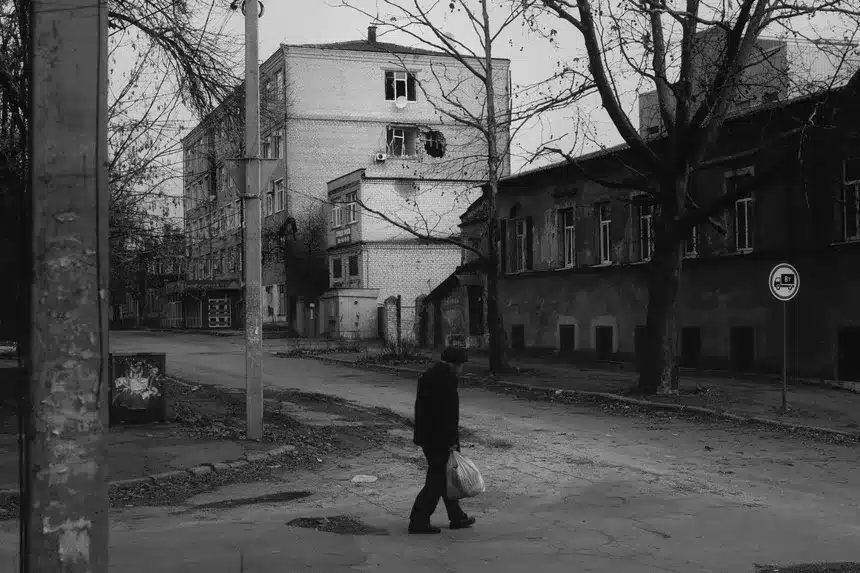


“Notes From a Besieged City”: Kherson beyond the headlines5 min read
“As they say, you shouldn’t fear the shell you can hear – you’ll never hear the one meant for you”.
There is something profoundly unsettling about the casualness with which the residents of Kherson discuss death. Explosions have become part of the city’s soundtrack, as familiar as traffic or church bells once were. The observation that a shell you can hear has already missed you is delivered almost as a practical reassurance. Yet behind this apparent indifference lies something far more disturbing: the extent to which human beings can become accustomed to living under constant threat.
This is the unsettling reality captured in Notes From a Besieged City (Zapiski z oblężonego miasta), a 2026 documentary by Polish filmmaker Mateusz Mularski. Rather than documenting military operations or the changing front lines, Mularski turns his camera away from the battlefield to capture something just as devastating – the slow erosion of ordinary life in Kherson, a southern Ukrainian city liberated from Russian occupation in November 2022 but never truly released from the war.
A liberated city without peace
For nearly nine months, Kherson lived under Russian occupation. Its liberation was celebrated as a major Ukrainian victory, with images of jubilant crowds briefly dominating international headlines, but the Russians did not retreat far. Their forces remain entrenched across the Dnipro River. Since then, artillery strikes, rockets and drones have continued to threaten the city and its inhabitants.
Filmed between 2023 and 2025, the documentary follows four residents who have chosen to stay. Among them are a humanitarian volunteer, a journalist originally from Russia, a photojournalist and an elderly woman. Their stories unfold not through dramatic revelations but through conversations, memories and seemingly insignificant daily rituals that help them get through the day. People drink tea, play cards, tend gardens and feed stray cats and dogs. They remember what Kherson looked like before the invasion and speak about neighbors who have left or have been killed, homes that have disappeared and how lively Kherson used to be before the war.
One of the film’s most affecting dimensions is precisely this insistence on ordinary life. A woman continues cultivating her garden, not because vegetables are the most pressing concern in a city under bombardment, but because maintaining a routine offers some defense against despair and gives her purpose. Elsewhere, people gather to talk, finding comfort in the simple presence of others. These moments are not necessarily expressions of heroic resistance. Sometimes they are simply attempts to remain sane and get through the day.
Turning the camera away from the battlefield
Mularski initially envisaged a documentary in which the military would play a significant role. However, as he explained in an interview with the International Documentary Association (IDA), during four visits to Kherson, amounting to approximately three and a half months, his attention increasingly shifted towards civilians. The resulting film is less concerned with how wars are fought than with how they are endured.
War documentaries often feature explosions, destroyed buildings, wounded soldiers and grieving families. These images are important, but after years of similar footage emerging from Ukraine, audiences can become increasingly desensitized to them. What once provoked shock and outrage can gradually become just another news report.
Notes From a Besieged City takes a different approach. Some of its most unsettling moments are those in which seemingly nothing happens. An empty street, an abandoned apartment or a conversation interrupted by distant shelling can be just as powerful as footage of a building being destroyed. It is through these ordinary moments that the film conveys what it actually means to live in a city at war, where even the simplest daily activities are overshadowed by the possibility of getting killed.
A city drained of color
The film’s visual language reinforces a particularly eerie atmosphere. Shot in black and white, it transforms Kherson into a place seemingly suspended outside ordinary time. Mularski has explained that the monochrome imagery was intended to communicate the unreality he experienced while filming. He also observed that the war had already drained much of the color from the city. His decision proves remarkably effective – without color, the ruined buildings, deserted streets and faces of the remaining inhabitants acquire an almost spectral quality. Kherson sometimes resembles an abandoned city from another century, although everything we are witnessing belongs unmistakably to the present.
Black-and-white photography carries the risk that it can make destruction look almost beautiful. Yet Mularski avoids romanticizing suffering by keeping the focus on the people who live among the ruins. The absence of color also reflects the monotony of life under constant threat, where one day begins to resemble the next and hopelessness lurks from every corner.
Why the world must not forget Kherson
As Russia’s full-scale invasion approaches its fifth anniversary, international audiences have grown accustomed to following the conflict through territorial gains, diplomatic negotiations and casualty figures. Kherson no longer receives the international attention it did when it was liberated. Yet the city’s suffering has not ended simply because it has ceased to dominate the news. Kherson remains a particularly painful illustration of the difference between liberating territory and restoring the conditions necessary for people to live safely. Its inhabitants continue to face attacks while essential services, social connections and the city’s economic life remain profoundly disrupted.
Mularski’s film shows that the consequences of war go far beyond territorial gains and military statistics. They are also visible in abandoned neighborhoods, the loneliness of those who remain and the psychological toll of living under constant threat. Notes From a Besieged City challenges the way international audiences follow the war in Ukraine. Kherson’s residents should not have to endure increasingly shocking tragedies to make headlines again. Their city deserves attention because the danger remains, despite its liberation.
Following its world premiere at the 2026 Krakow Film Festival, where Joanna Zielińska received the Best Producer award, Notes From a Besieged City had its international premiere at the International Documentary Film Festival Amsterdam (IDFA) in November 2026.