

Mova Nanova: Defending a language under siege with gatherings, games, and guests9 min read
As Russia’s war on Ukraine continues raging, Belarus eagerly seeks rapprochement with the West through negotiations over a potash deal with the Trump administration, meetings with high-profile American emissaries, and renewed ministerial contacts with Poland. The dictatorial record of Belarus’s self-proclaimed leader Aljaksandr Lukashenka since his fraudulent presidential election of August 2020 has been characterized by brutal repression at home and acquiescence to Putin’s Russia in its blatant challenges to a rules-based international order, from the violent suppression of mass protests against his usurpation of power, imprisonment of opposition leaders, and torture of detainees in the aftermath of the election to the instrumentalization of migrants to pressure neighboring EU states. Since February 2022, the Lukashenka regime has provided territory and logistical support for Russia’s still-ongoing full-scale invasion of Ukraine, including missile launches from Belarus and the production and supply of ammunition and missile components, alongside relay stations deployed in 2025 to control Russian attack drones.
Shortly before this rapid intensification of authoritarian rule, nonetheless, a grassroots initiative to promote the everyday use of the Belarusian language, known as Mova Nanova (“Language Anew”), proliferated across the entire country and beyond in slightly more than half a decade amid state surveillance, economic decline, high rates of emigration, and the Covid pandemic. From its foundation in 2014 to the official liquidation of its registration in 2021, through a combination of informal gatherings, interactive events, professional exchange, and social media activities, Mova Nanova brought together thousands of Belarusians keen on preserving their language in lighthearted weekly meetups (sustrečy) across all major cities of the country and showcased a uniquely creative way to transform cultural identity in the digital age in the face of authoritarian control and repression.
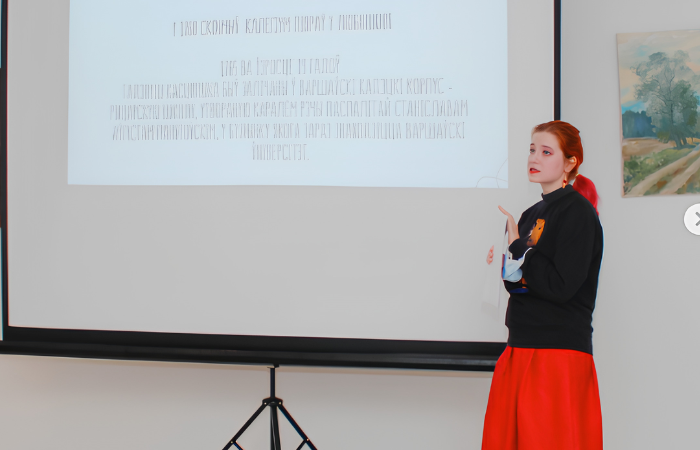
Mova Nanova’s operating principles were predicated on the active use of Belarusian across personal and professional contexts, cultural activities, and social interaction. The initiative’s first meeting took place in January 2014 in Minsk under the direction of philologist Aliesja Litvinoŭskaja and journalist Hlieb Labadzienka. Sessions typically combined grammatical exercises and conversational practice with games, literary discussions, musical performances, storytelling, poetry reading, and presentations by invited speakers, who spoke in Belarusian about their work and areas of expertise. The project’s expansion across the urban areas of Belarus depended largely on local volunteers, with local chapters choosing their own topics, guests, and teaching materials while exchanging resources and arranging visits across cities.
In October 2026, I sat down for an interview with Darja Roskač, an educator from Babrujsk who led her hometown’s Mova Nanova chapter in 2019-2020. Although she took up the leadership of her local chapter nearly half a decade after its establishment, she brought considerable experience in teaching and managing social media platforms devoted to Belarusian and participated in the project’s activities in other cities in Belarus until mid-2020. After 2021, she continued her involvement in Vilnius, where she now lives.
What place does Belarusian occupy in everyday life in Belarus today?
A relatively small number of people in Belarus use Belarusian daily, and some consciously maintain this practice to preserve it. Some active speakers may avoid speaking it in public spaces out of caution, while those same people may continue to post in Belarusian on social media, often about apolitical subjects. Belarusian is still taught in schools, although class hours and opportunities to study it remain limited. There is demand from parents for greater educational provision, especially in urban areas, while Russification is intensifying in the countryside. Passing Belarusian on to children depends heavily on individual and family decisions. Some parents read bedtime stories in Belarusian and enroll their children in classes and extracurricular activities conducted in it.
How has the political climate surrounding Belarusian changed since 2020, especially given its nominally official status?
Belarusian nominally retains official status under the Constitution. It has long been an instrument of the opposition, although before 2020 there remained scope for apolitical use of the language in cultural, educational, and institutional contexts. The fraudulent presidential election of 2020 and the subsequent mass protests and repression marked a watershed, with independent cultural activities facing increasingly severe restrictions as the regime moved closer into Russia’s political orbit. Initiatives promoting Belarusian have since become fewer and smaller in scale. Even state-endorsed events such as the annual Belarusian Writing Day (Dzień bielaruskaha piśmienstva) are conducted predominantly in Russian. Many Belarusian-language writers in Belarus have been arrested, while others have emigrated or stopped writing in Belarusian.
What was the philosophy behind Mova Nanova, and how did its volunteer network operate across Belarus?
Mova Nanova aimed to provide free opportunities for anyone interested in learning and using Belarusian. Its informal educational approach emphasized conversation and the exchange (abmien) of experience, with participants and “guests” (hosci) encouraged to discuss their work and areas of expertise in Belarusian. Almost all organizers were volunteers who arranged meetings, prepared materials, and invited speakers. By the late 2010s, chapters operated across the country, with local organizers choosing their own topics and resources while exchanging materials with other chapters. Active participants frequently traveled between cities to speak at meetups and contribute to events beyond their own communities. Alongside the regular free meetups, the initiative also offered low-cost courses for students enrolled in higher education.
Who attended the meetups?
The meetups attracted participants from all age groups and varied professional backgrounds. A notable number of pensioners attended regularly, some specifically seeking opportunities to converse in Belarusian. Some teachers often brought their students, while many parents often attended with their children. Some children remained involved over such extended periods that they “grew up” alongside the project. Certain literary events were restricted to adults because invited writers were known for their use of uncensored language or their tendency to discuss violent subjects. However, even older attendees did not noticeably express discomfort at these events and often interacted cheerfully with the speakers.
What were the meetups like?
Long-term participants helped maintain a friendly atmosphere, and the meetups were generally interactive and informal. Guests gave presentations in Belarusian about their professional backgrounds and encouraged discussion of professional interests and everyday activities. Some events featured musical performances, literary discussions, or meetings with notable Belarusian cultural figures. There were also other activities that incentivized attendees to think of the Belarusian language from unconventional perspectives. For example, tea ceremony masters discussed Belarusian terminology associated with tea while explaining or demonstrating tea ceremonies. Guest appearances varied between chapters, and meetings in smaller cities like Babrujsk and Salihorsk did not always feature a “guest” or visiting speaker.
How did local chapters plan their meetings and choose their materials?
Participants discussed topics and guests for future meetings, as well as possible special events at alternative venues. Some sessions included grammar exercises led by experienced pedagogues and specialists in Belarusian. Materials varied by chapter, and chapters could select resources for their meetups. Organizers drew on books, the internet, and other existing resources, while chapter leaders often prepared their own materials. Materials developed locally were often posted on social media and shared between chapters.
Where were the meetups typically held?
Cafés and restaurants often provided meeting spaces for local chapters, which generally returned to the same venue for their regular sessions. Participants also discussed alternative locations for special events. These establishments could benefit commercially from attendees ordering food and drinks. However, hosting the meetups also exposed the businesses to official scrutiny. Many of the cafés and restaurants that provided venues have closed since 2020, including the one in Babrujsk.
How did Mova Nanova manage its online presence?
Chapters used social media to announce events and share materials. Many participants first joined through word of mouth from friends, family members, or teachers. Since 2020, much of the initiative’s online content has been deleted or made private, and many webpages and social media pages have been removed amid fears of repression. Former chapter leaders may still have materials stored on their computers. Those in Belarus risk having their computers searched by the security apparatus, while participants living abroad face fewer risks in preserving such material.
What has involvement in Mova Nanova meant to you personally?
I made enduring friendships thanks to my involvement in Mova Nanova. I also met my future spouse through the initiative. I have fond memories of meetings with notable Belarusian cultural figures like Andrej Chadanovič, whom I hosted at our chapter’s meetups.
How did the repression following the 2020 protests transform the initiative?
Already during the Covid pandemic, health concerns and local restrictions prompted some chapters to move their online, although Belarus did not introduce a nationwide lockdown in 2020. Meetups continued during the 2020 election period, but mass arrests and fear of repression subsequently disrupted the initiative on a wide scale. In 2021, the authorities liquidated Mova Nanova’s registered institution. Many members emigrated, while fear and logistical difficulties led most groups to discontinue their meetups within the country. Numerous related social media pages were later designated “extremist materials” (ekstrymisckija materyjaly) by the de facto authorities, including through court decisions in 2024. The authorities’ close monitoring of social media and extremist designations affecting some former “guests” and invited speakers have also made the situation precarious for former organizers and participants.
How has Mova Nanova continued abroad?
Some former members have continued Mova Nanova’s activities abroad, particularly in cities with substantial Belarusian émigré communities. Some of these activities have been covered by overseas media outlets like Belsat. In Vilnius, the long-established Belarusian community and more recent émigrés have access to Belarusian schools, museums, and other cultural and educational institutions that support the study and preservation of Belarusian. Mova Nanova groups in cities like Warsaw, Wrocław, Kraków, Białystok, and Riga remain active and attract substantial numbers of participants. Other opportunities to use Belarusian in places like Vilnius include online initiatives, musical and folk events, pub quizzes, and gatherings hosted by museums, cultural associations, and local businesses. Smaller groups also operate in other countries, although many limit their online publicity for fear of repression back in Belarus.
What are some other efforts to preserve and develop Belarusian outside Belarus?
There are long-established institutions like the Skaryna Library in London that provide resources for Belarusian studies. Publishing and translation abroad remain important means of preserving, popularizing, and developing Belarusian. The Belarusian language has emigrated, as almost all Belarusian-language literature is now published abroad. Translators and publishers outside the country continue to produce a wide range of Belarusian books, from poetry to translations of works by authors like Remarque. Many of these editions cannot even be sold in Belarus. For example, a Belarusian edition of Harry Potter is subject to contractual restrictions that prohibit its sale in Belarus due to sanctions against the country.