

A forgotten Kyrgyz film about creativity in an indifferent world: “Castles in the Sand” at the 2026 Samizdat Film Festival8 min read
In the 1968 short documentary Castles in the Sand, a young boy transforms the shores of Kyrgyzstan’s Lake Issyk-Kul into a world of his own imagination. Yet while others admire his creations, few seem to appreciate the effort behind them. More than half a century after its release, this little-known work of Soviet Kyrgyz cinema offers a surprisingly contemporary reflection on creativity, recognition and perseverance.
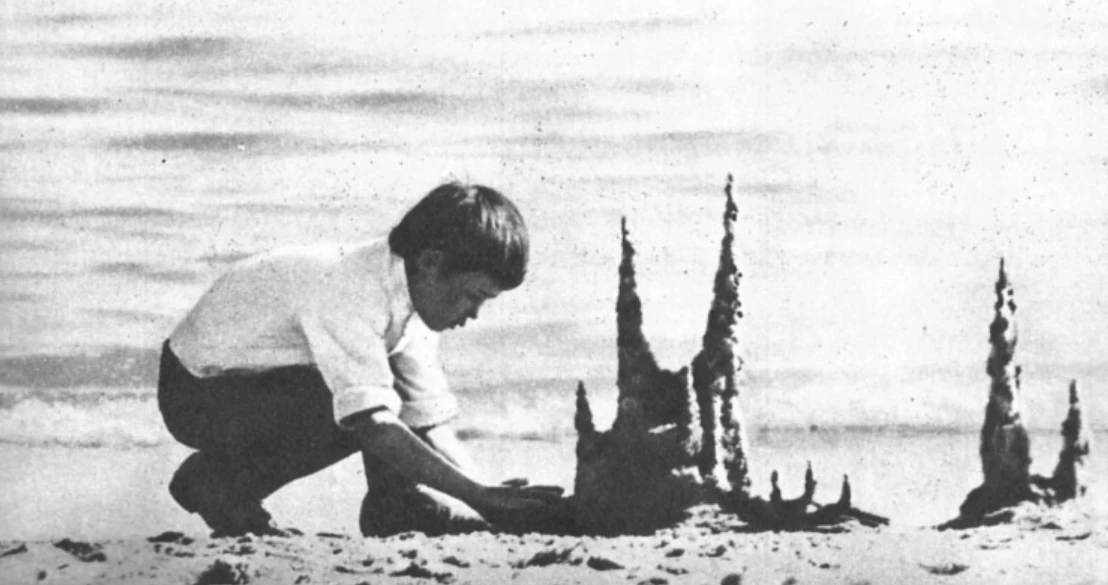
On the shores of Lake Issyk-Kul, a young boy patiently constructs an elaborate castle out of sand. Around him, holidaymakers enjoy the beach, apparently unaware of the imagination and concentration required to transform an ordinary stretch of shoreline into something extraordinary. Some stop to admire his work, while others seem more interested in photographing themselves alongside it than acknowledging its young creator.
In just seventeen minutes, Castles in the Sand (Замки на песке, 1968), directed by Algimantas Vidugiris and Yakov Bronstein, turns this seemingly simple childhood activity into a reflection on creativity, persistence and society’s often contradictory relationship with those who think differently.
Produced by the Kyrgyzfilm studio during the Soviet period, the documentary follows Kanatbek, a young boy whose imagination appears almost limitless. Where most visitors see sand, water and a place to relax, he sees the foundations of an entire architectural world. His castles are intricate, ambitious and surprisingly sophisticated, particularly given the fragility of the material with which he works.
Yet the film is not simply a celebration of childhood creativity. Beneath its gentle humour lies a sharper observation about how society responds to originality, and how easily admiration for an artistic achievement can coexist with indifference towards the person responsible for it.
The imagination of a child
What makes Kanatbek such a compelling protagonist is the seriousness with which he approaches his creations. Building sandcastles is usually associated with a carefree childhood pastime, but for him it becomes something closer to an artistic vocation. He experiments, refines his techniques and pays extraordinary attention to detail. The scale and complexity of his constructions reveal both imagination and practical ability. His creativity is not merely spontaneous inspiration; it also requires patience, concentration and considerable effort.
The contrast with the surrounding beachgoers is striking. While they enjoy their leisure time, Kanatbek remains absorbed in his work. He appears to inhabit the same physical space as everyone else but approaches it with an entirely different perspective. This difference is central to the film’s appeal. Kanatbek does not accept the beach simply as he finds it. He imagines what it could become.
Vidugiris and Bronstein capture this process with tenderness and an understated sense of humour. Rather than explaining the boy’s creativity through extensive commentary, they allow his actions to speak for themselves. The documentary’s observational approach invites viewers to appreciate not only the finished castles but also the ingenuity and determination involved in constructing them. In doing so, the filmmakers offer a portrait of artistic talent that feels remarkably universal. Creativity emerges not as an abstract quality possessed by a privileged few, but as an ability to perceive possibilities where others see only ordinary materials.
Everyone admires the castle, but who remembers its creator?
Perhaps the film’s most revealing moments concern the reactions of those around Kanatbek. As his constructions take shape, beachgoers become interested in the results of his labour. Some photograph themselves in front of the sandcastles, turning the boy’s achievements into attractive backdrops for their own holiday memories. There is something amusing about these encounters, but also something uncomfortable. The visitors appear delighted to associate themselves with the finished creations, even though they have contributed nothing to making them.
The scene raises an intriguing question: why are people sometimes so eager to enjoy or display the results of someone else’s creativity while showing so little interest in the person behind it?
Viewed today, the behaviour of these holidaymakers invites an unexpected comparison with debates surrounding authorship, intellectual property and the appropriation of creative work. The visitors are not necessarily claiming legal ownership of Kanatbek’s castles. Nevertheless, their desire to photograph themselves alongside his work, almost as though it were their own achievement, reflects a familiar social tendency: to seek recognition through proximity to something impressive without acknowledging the labour that produced it.
In an era when photographs, artworks and other creative productions circulate effortlessly across social media, often detached from their original creators, this aspect of the film feels surprisingly contemporary.
Of course, it would be anachronistic to suggest that the filmmakers intended to comment on today’s copyright disputes or digital culture. Yet the broader question of recognition remains relevant across generations. This contrast is particularly revealing because Kanatbek himself appears far less concerned with attracting attention than with creating something worthwhile. While others enjoy the prestige of being photographed beside his castles, he derives satisfaction from the act of building them.
The film thus distinguishes between two very different relationships with creativity: the desire to produce something original and the desire to be associated with an impressive result.
Persistence in the face of indifference
Kanatbek’s imagination would already make him an engaging protagonist, but it is his perseverance that gives the documentary its emotional weight. Building castles out of sand is inherently frustrating. The material is fragile, the shoreline unpredictable and the creations vulnerable to destruction. What takes considerable effort to construct can disappear in moments. Yet Kanatbek refuses to surrender to these limitations.
When his work is damaged or washed away, he begins again. He experiments with new approaches, adjusts his techniques and continues building despite repeated setbacks. His determination is especially impressive because success is never guaranteed. Unlike an artist working with more durable materials, Kanatbek knows that even his most elaborate creations may not survive.
There is something almost philosophical in this struggle. The boy is engaged in a process where the value of his work cannot be measured solely by its permanence. The castles matter because he creates them, not because they will last forever. His repeated attempts also challenge the assumption that creativity is primarily about inspiration. The documentary suggests that imagination becomes meaningful through persistence, through the willingness to fail and try again.
Importantly, the film does not portray everyone around Kanatbek as indifferent or selfish. His dedication can also inspire curiosity and admiration. The reactions of the beachgoers reveal a range of attitudes towards creativity, from superficial fascination to a more genuine appreciation of his efforts. This complexity prevents the story from becoming a simplistic opposition between a gifted child and an uncaring society. Instead, it explores how originality can provoke admiration, misunderstanding and indifference, sometimes simultaneously.
A small treasure of Kyrgyz cinema
Beyond its universal themes, Castles in the Sand also deserves attention as a work of Soviet Kyrgyz cinema. Released in 1968, the documentary emerged during an important period for filmmaking in Soviet Kyrgyzstan, when directors increasingly explored local experiences and landscapes through distinctive cinematic approaches.
Rather than presenting the country’s natural scenery merely as a picturesque backdrop, Vidugiris and Bronstein use the shores of Issyk-Kul as an essential part of their storytelling. The lake, the sand and the movement of the water become active elements in Kanatbek’s creative struggle. The film’s visual simplicity is one of its greatest strengths. Its black-and-white imagery, attention to gesture and restrained storytelling allow an ordinary childhood activity to acquire the dimensions of a poetic allegory. The result is a film that requires little explanation to communicate its central ideas. The relationship between creation and destruction, persistence and discouragement, recognition and indifference is immediately understandable.
The film’s artistic achievements were recognised internationally. Castles in the Sand received several awards, including the prestigious Golden Dragon of Wawel at the Kraków International Short Film Festival, as well as recognition at festivals in Tehran and Tampere. Despite these successes, the documentary has remained relatively unfamiliar to international audiences. Its digitisation in 2024, through a project involving Kyrgyzfilm, the Central State Film Archive and the Turkish Cooperation and Coordination Agency, has helped make this remarkable work accessible to a new generation of viewers.
Its inclusion in the 2026 Samizdat Eastern European Film Festival provides another opportunity to rediscover a film whose modest premise conceals considerable artistic ambition.
The value of creating something that cannot last
Ultimately, Castles in the Sand is a film about much more than a talented child building extraordinary structures on a beach. It asks viewers to consider how society responds to people who approach the world differently, and whether admiration for creativity necessarily translates into respect for those who produce it.
Kanatbek’s castles attract attention because they are beautiful and unusual. Yet the most remarkable achievement is not any individual construction, but the imagination, resourcefulness and determination that make them possible. There is also something quietly moving about the boy’s willingness to begin again. He understands, perhaps more intuitively than the adults around him, that the value of creation does not necessarily depend on permanence or public recognition. The beachgoers may leave with photographs of his castles, preserving images of something they did not create. The structures themselves may eventually disappear beneath the waves. But Kanatbek possesses something that cannot be washed away: the ability to imagine and create something new.
More than half a century after its release, Castles in the Sand remains a remarkably perceptive reflection on a familiar contradiction. Society celebrates originality, yet does not always recognise, respect or support the individuals who make it possible. And while others are content to admire or photograph the finished castle, Kanatbek has already begun imagining the next one.
Castles in the Sand (Замки на песке, 1968), directed by Algimantas Vidugiris and Yakov Bronstein and produced by Kyrgyzfilm, was featured in the 2026 Samizdat Eastern European Film Festival.