

Performative transparency in “Comrade Policeman” at the 2026 Samizdat Film Festival4 min read
Comrade policeman, Assel Aushakimova’s 2021 satirical short film, depicts the attempts of state media to capture a Kazakh police PR stunt. It shows the disparity between media, law and order and public opinion – coming to the fore with the acting citizen stumbling over the very word “comfortable”.
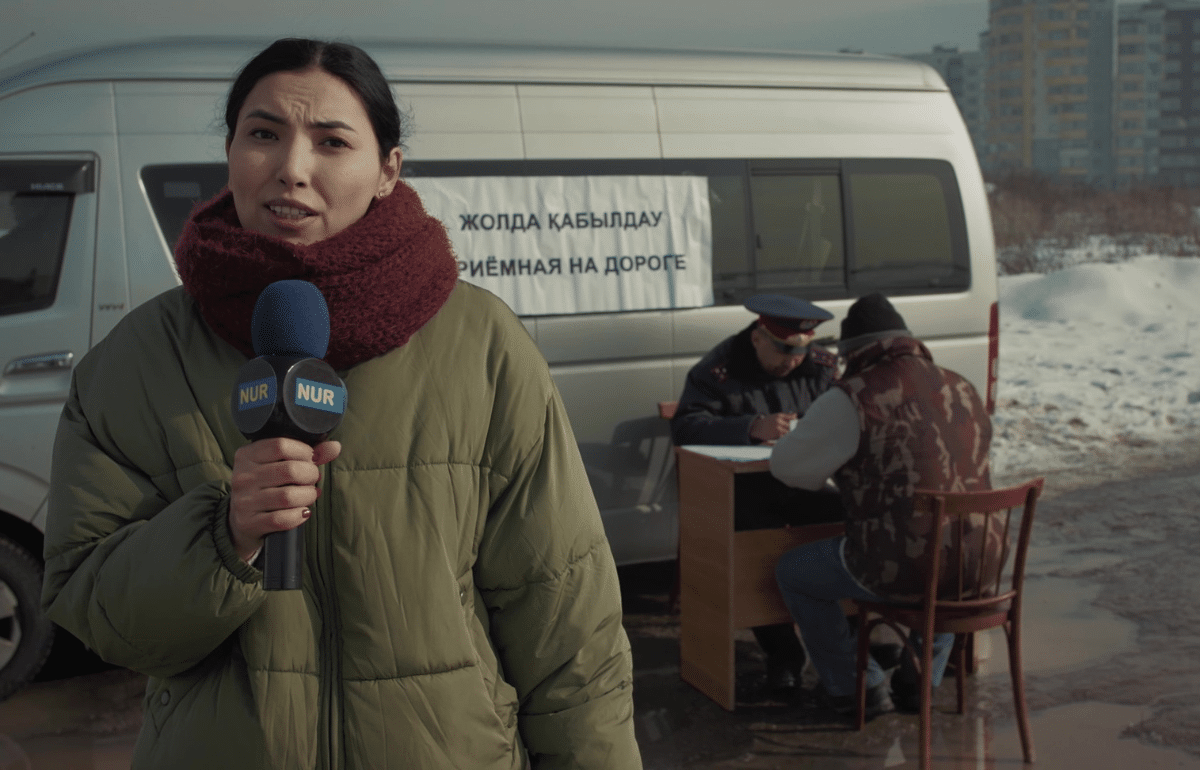
Opening scenes depict a young journalist waiting for her accompanying cameraman to go to the toilet – under the bright blue sky and directly onto the crisp white snow. His camera, lying carelessly on the ground, sits precariously close to the growing puddle, and as we follow him back towards the journalist, crouched down and scribbling notes for her interlocutors, it seems a charade is about to unfold.
As though commencing a quest requiring multiple characters, the journalist collects her civilian interviewee from his car after waking him from slumber. The trio trek along an icy road towards a nondescript van parked next to a seemingly random desk and chairs, one of which is occupied by a reticent-looking policeman.
With Kazakh police suffering from a bad image, the news piece is intended to advertise an upcoming event. The event promises a free exchange between citizens and the police, in order to promote openness and transparency. Ironically, when the interviews commence, transparency is the last thing on anyone’s mind.
Drinking an energy drink and listening to music while hunched over in one of the two available chairs, the policeman appears far from approachable as he is handed a sheet of notes in preparation for his interview. He remains blind to the presence of the civilian until he is pointed out by the journalist, who seats the two men in front of each other and begins tidying up the set. The journalist readies her two subjects for the piece, ensuring both have their lines in front of them.
Not even the journalist herself is free from interference, and as she commences her rhetoric, the cameraman interrupts her to correct “Astana” with “Nur-Sultan.” Reflecting the intriguing dynamic between state narrative and reality, the roadside police show is apparently due to take place for the sixth time – not that the policeman seems to know anything about it. Mid-speech, the cameraman stops and shouts over to the policeman, calling him “comrade” – to which the journalist replies a snide comment about a homonymous American film. The exchange draws attention to the clash between Soviet political language and contemporary Kazakh media practices, linking the act of image-making through time.
Throughout the procedure, the policeman remains decidedly unimpressed, particularly when dragged up for his own interview. He takes his time, stopping to tie his shoes and brush down his sleeves before giving the journalist dry and unenthusiastic answers – some of which are at the direct instruction of the journalist. His time in the limelight culminates with a lengthy silence – in response to a question about whether or not he had received any civilian complaints.
Having been practising his lines in the background, the civilian stands up for his interview, stuttering over his answers. Despite instructions to use his own words rather than recite from memory, toeing the line leaves little breathing room as he struggles through each response. Coughing and looking uncomfortable, it makes for poor television, but the media team wrap up shortly afterwards in exasperation, leaving the disgruntled policeman to busy himself by the side of the road.
Whether the civilian was jittery due to nerves or something broader is up to interpretation. Aushakimova uses her characters to expose the performance of transparency and the interlinking relations between state and subjects. Through a satirical lens, she reveals a public dialogue that has been scripted before the record button is pressed. Questions and answers are distributed in advance, and repeated takes and corrections affront even supposedly spontaneous interactions.
With the policeman expressing indifference from start to finish, the cameraman coaching his colleague and the civilian parroting half-memorised statements, everybody is painfully aware of the staged nature of the affair. This only serves to highlight the gap between the official line and lived experiences – achieving the opposite of the trust a PR stunt aims for.
Aushakimova’s deliberate use of silence, repetition and lethargy portrays an overt political critique underlining a sense of bureaucratic exhaustion. The film stages a world in which everyone appears trapped within a performance that nobody believes in. Her satire is remarkably restrained, offering an exposé of the gap between the language of transparency and how it plays out in reality. In Comrade Policeman, openness becomes the very opposite of its traditional meaning: not a democratic principle or key element of trust but simply a script.
Comrade policeman (2021) was screened as part of the 2026 Samizdat Eastern European Film Festival.