

Moldova gained its freedom but lost its mothers: “Love Is Not an Orange” at the 2026 Samizdat Film Festival9 min read
Through family videotapes exchanged across borders, Otilia Babara’s documentary reconstructs the emotional cost of Moldova’s post-Soviet migration. Speaking to Lossi 36, the director reflects on absent mothers, the children they left behind and the wounds that remain decades later.
In the Moldova of the 1990s, love often arrived in cardboard boxes. Sent from Italy, Greece and other European countries, they contained clothes, sweets, toys and oranges – small luxuries that had become difficult to afford in a country struggling with the economic consequences of the Soviet Union’s collapse. The women who sent them were mothers who had left Moldova in search of work, sometimes for years, leaving their children in the care of relatives.
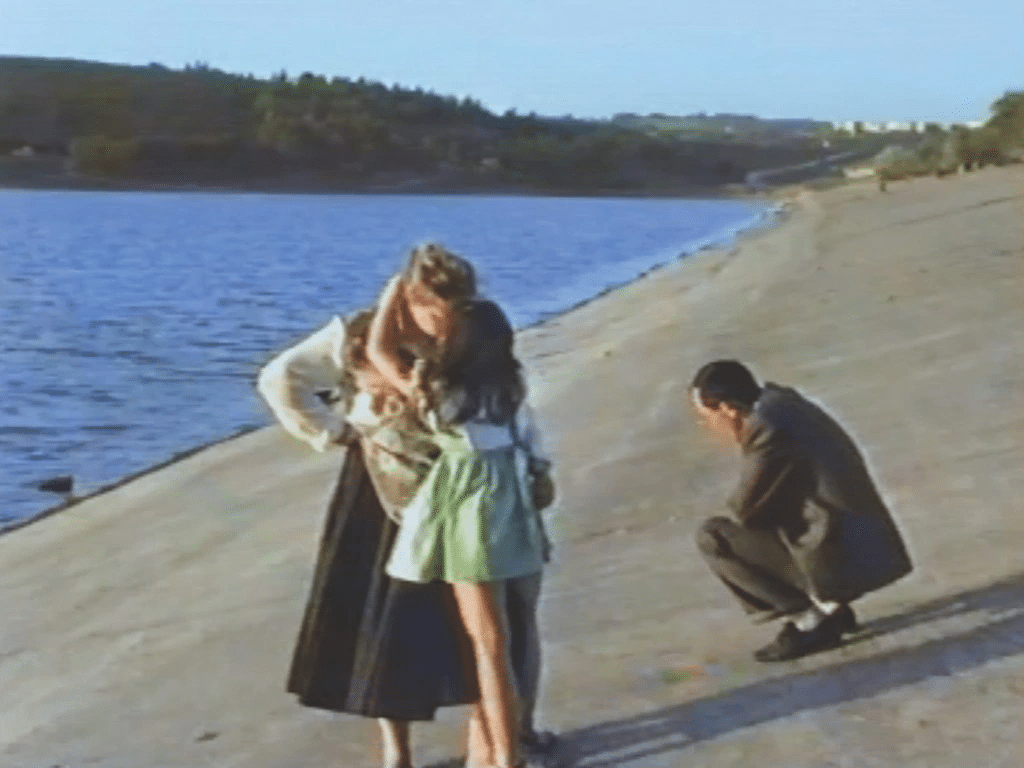
In return, their families sent videotapes. Children spoke into cameras, celebrated birthdays, displayed their achievements and reassured their absent mothers that everything was fine. These recordings became a substitute for everyday communication, preserving fragments of family life across borders that were expensive and difficult to cross.
In Love Is Not an Orange (2022), Moldovan filmmaker Otilia Babara transforms these private recordings into a collective portrait of a country profoundly reshaped by migration. Screened at Glasgow’s Samizdat Eastern European Film Festival on 9 October 2026, the 73-minute documentary is both an intimate exploration of family separation and a reflection on the largely unacknowledged contribution of women to Moldova’s survival during its transition from communism to capitalism.
When the camera becomes a mother
One of the documentary’s most striking ideas is the transformation of the family video camera into an intermediary between absent mothers and the children they left behind. Today, when video calls make it possible to speak across continents almost instantaneously, the practice may seem unfamiliar. In the 1990s, however, international telephone calls were expensive, communication was infrequent and travel restrictions could keep migrant workers separated from their families for years.
A second-hand video camera offered something different: the possibility of recording everyday moments and sending them abroad, allowing mothers to see their children growing up even when they could not be physically present. But these recordings were more than simple documentary evidence. They were carefully constructed messages, shaped by what families wanted their absent loved ones to see.
“The performance is an example of this language, a way to say I miss you and reassure the mother that things are going well,” Babara told Lossi 36.
For the director, the tapes represent attempts to establish a language of longing and care.
This observation reveals a central tension in the documentary. The camera captures moments of affection and celebration, but it also makes visible what is missing. Behind the smiles, performances and family gatherings lies the knowledge that someone important is watching from another country, unable to participate.
The footage carries an emotional complexity that conventional interviews might struggle to reproduce. The people appearing in these recordings were not performing for a future documentary audience. They were addressing someone they loved, someone whose absence gave each recording its purpose.
The archive therefore allows viewers to witness not just the consequences of migration, but the ways families attempted to overcome them.
The women who sustained Moldova
The mass departure of Moldovan women cannot be separated from the economic collapse that followed independence in 1991. The disintegration of Soviet-era economic structures, unemployment, declining living standards and the limited availability of work pushed thousands to seek opportunities abroad.
For many households, migration became a survival strategy. Women took jobs in domestic work, cleaning and caregiving, often supporting families in Moldova while caring for other people’s households in Western Europe. Their earnings helped provide food, clothing and opportunities that would otherwise have remained out of reach.
Yet this economic contribution came at a considerable personal cost. Babara argues that the role of these women has never been adequately recognised.
“Their role was never acknowledged or recognized,” she says. “More than that, many of them felt and feel dismissed by their families for putting the material care before the physical presence.”
The contradiction is painful. Mothers who left to provide for their children could subsequently be criticised for not being there to raise them. Financial support, however essential, could not necessarily compensate for years of physical separation.
“The work they did, as most care work that is being done everywhere, remains unfortunately invisible and poorly paid,” Babara adds.
This gives Love Is Not an Orange a broader political dimension. The film is not simply about individual decisions to migrate, but about the burden placed on women during a period of profound economic transformation. The boxes sent home contained the material evidence of their labour. Yet they could not replace the relationships that had been interrupted.
The title itself captures this contradiction. An orange can be a gift, a reminder of care, even a small symbol of prosperity. But it cannot substitute for love expressed through physical presence.
A childhood shaped by absence
While the mothers’ sacrifices provide one perspective, the documentary also foregrounds the children who grew up without them.
For some, the absence lasted through formative years. Children became teenagers, family relationships changed, and the prospect of reunion sometimes grew increasingly distant. The videotapes preserve different stages of this experience. Childhood enthusiasm and playful messages gradually give way to more complicated emotions as the children grow older.
Babara believes the consequences have extended well into adulthood.
“Every generation has its own traumas and every case is different but inevitably the forced separation has left its marks,” she explains. “Many of these adults today live with the trauma of abandonment and some grew up to be overprotective parents.”
Her observation raises an important question: what does family reunification actually mean after years of living apart?
Returning home does not automatically restore the intimacy that existed before departure. Parents and children may have developed different expectations, habits and understandings of one another. The desire to reunite can coexist with emotional distance.
Indeed, the documentary initially emerged from Babara’s interest in precisely this difficulty. She had planned to explore the relationship between her best friend and her friend’s mother, who had returned from Greece after 12 years abroad. During filming, however, Babara realised that the experience could not be understood through a single family alone.
“A big part of the Moldovan families were, and still are going through the same disconnect,” she told Lossi 36.
The discovery of the family archives transformed the project.
“It became very important for the film to shape a collective memory of these people and of this phenomenon. A mirror to what they’ve been through, collectively. Providing a point of departure to heal and destigmatize migration.”
Instead of concentrating on one reunion, Babara constructed a documentary from recordings made by families who had experienced similar separations. This approach gives the film its distinctive character. Individual stories are not reduced to illustrations of a general historical argument. Rather, the accumulation of intimate moments reveals the scale of a shared social experience.
A country between departure and belonging
The documentary also raises questions about the relationship between migration and national belonging. For children who grew up with parents abroad, Moldova could simultaneously represent home, family, economic insecurity and the possibility of leaving.
Babara describes the relationship of this generation with Moldova as complex.
“I believe it oscillates between a sense of fragmented belonging that usually ends up in emigration, or a strong sense of attachment to Moldova,” she says.
This tension extends beyond the specific generation portrayed in the film. Moldova has experienced decades of outward migration, with families spread across Europe and beyond. Migration has become part of the country’s social fabric, transforming not only its economy but also its understanding of family, identity and opportunity. Yet Babara cautions against assuming that the Moldova of today is identical to the one depicted in her documentary. The difficulties of obtaining visas, the pattern of mothers departing alone and the prolonged separations caused by restrictive travel conditions were particularly characteristic of the 1990s.
“Many things have changed since and for the better,” she says, pointing to Moldovans who have chosen to return after years abroad.
What remains, in her view, is a persistent sense of insecurity.
“In the 90s it was financial, while today it comes from the war happening next door.”
Russia’s full-scale invasion of neighbouring Ukraine has brought a different set of uncertainties to a country still negotiating the legacy of its post-Soviet transformation. The sources of anxiety may have changed, but the question of whether a secure future can be built at home remains deeply relevant.
Remembering those who left
What makes Love Is Not an Orange particularly compelling is its decision to construct a historical narrative through ordinary family recordings rather than official archives or political speeches. The collapse of the Soviet Union is often recounted through independence declarations, economic reforms, geopolitical realignments and institutional change. Babara approaches the same transformation through the lives of mothers and children. Her documentary suggests that the history of Moldova’s transition cannot be understood without acknowledging the women who left to support their families and the emotional consequences borne by those who remained.
The archival approach also gives the film a particular intimacy. These are images created to communicate affection across distance, not to explain history. Yet together they reveal how deeply historical upheaval entered private life. There is an important distinction between documenting suffering and allowing a society to recognise it as part of a shared experience. Babara’s film aspires to do the latter. It does not offer a simple resolution to the tensions between economic necessity, maternal responsibility and childhood abandonment. Nor does it suggest that migration can be understood exclusively through loss. The same journeys that divided families also helped sustain them. Instead, Love Is Not an Orange invites viewers to consider the contradictions of an era in which leaving became, for many women, an expression of care.
For Moldova, remembering this experience is not only a matter of looking back at the hardships of the 1990s. It is also a way of recognising how migration has shaped the families, identities and expectations of successive generations. The cardboard boxes have long since been opened, their contents consumed or forgotten. But the videotapes remain, preserving the voices of children speaking to mothers who were far away. And through them, a country remembers what separation cost.
Love Is Not an Orange (2022), directed by Otilia Babara, was screened as part of the 2026 Samizdat Eastern European Film Festival. The article includes original comments provided by the director to Lossi 36.