

“My Erebuni has become Yerevan”: The Soviet modernization of the “ancient” Armenian capital12 min read
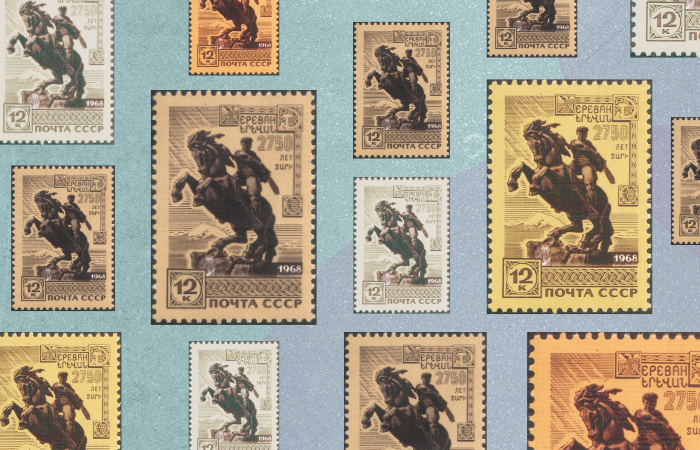
On October 11, 2026, Yerevan, the capital of Armenia, will celebrate its annual City Day in honor of the 2,808th anniversary of the city’s founding. The holiday originated in 1968, when Soviet Armenia marked the 2,750th anniversary of its capital. The chronology came from Erebuni, an Urartian fortress founded in 782 BCE whose ruins stand on Yerevan’s southern outskirts, rather than from the modern city’s founding. The inaugural Yerevan Jubilee in 1968, therefore, joined two distinct urban histories, separated by geography, urban form, and more than two millennia of historical change. It also established a civic tradition that outlived the Soviet state that created it.
Building a national capital in Soviet Armenia
Some scholars, most notably Adam T. Smith, have identified archaeology as the dominant organizing principle in the Soviet-era construction of Yerevan’s modern city center. This emphasis highlights the importance of Erebuni and other references to Armenia’s ancient past but falls short of accounting for the broader political and ideological principles that set the parameters for Yerevan’s Soviet-era reconstruction. Under Soviet nationality policy, best encapsulated by the official slogan “National in form, socialist in content,” Soviet authorities drew upon pre-Bolshevik cultural legacies identifiable as Armenian and adapted them to the political and ideological requirements of the building of national institutions within a broader Soviet political framework. Ancient ruins formed part of this material alongside historical events, architectural traditions, literary figures, epic heroes, and, specifically in the Soviet Armenian context, locally quarried volcanic stone. As the capital of Soviet Armenia within the Soviet ethno-national territorial framework, Yerevan was expected to appear recognizably Armenian while remaining politically and ideologically Soviet. Archaeology supplied visual motifs that were appropriated and integrated into the city’s reconstruction, rather than the dominant principle that organized it.
Yerevan’s reconstruction in the early Soviet period acquired particular symbolic weight from Armenia’s history of political displacement. Armenian historical tradition identifies a succession of thirteen capitals, many of which lost their political centrality amid wars, imperial conquests, or the collapse of Armenian statehood. Soviet reconstruction presented Yerevan as a permanent national center and as evidence of the stability that Soviet rule had brought to the Armenian people, whose population was, and continues to be, dispersed across the world. The principal architect of this transformation was Aleksandr Tamanyan, a Russian-born, Saint Petersburg-educated Armenian architect whose 1924 general plan reorganized much of the city around broad European-style avenues, public squares, and monumental administrative and cultural buildings. His designs combined European neoclassical planning with elements identified with traditional Armenian architecture, most notably bas-reliefs in the shape of grapevines inspired by traditional Armenian khachkars (cross-stones), which gave the new republican capital a recognizably national appearance. The imposition of Socialist Realism as the state’s cultural orthodoxy during the 1930s changed both the institutional conditions of architectural production and the political purposes assigned to monumental construction. Later buildings continued to employ Armenian national motifs, but their production belonged to a more centralized and ideologically prescriptive cultural order.
Reconstructing a socially and architecturally layered city
The construction of the new capital accompanied equally consequential ethno-demographic transformations and altered Yerevan’s inherited urban fabric. At the time of the Russian conquest in 1828, Yerevan, then more commonly known as Erivan or Irävan, was a predominantly Shia Muslim, Turkic-speaking city shaped by several centuries of Persian rule. Armenian migration from Persia increased after the first waves of Russian conquest of the South Caucasus in the early nineteenth century, while successive arrivals of Ottoman Armenian refugees during the Armenian Genocide and its aftermath a century later placed further pressure on the city’s limited housing and infrastructure. These demographic changes accelerated under Soviet rule. The Soviet policy of indigenization (korenizatsiya) promoted Armenians as the titular nation within republican institutions and public culture, while industrialization drew large numbers of rural Armenians into the urban workforce. Refugee settlement and officially sponsored “repatriation” (hayrenadardzut’yun) also strengthened the Armenian majority. The departure of much of the Muslim population coincided with the disappearance of mosques, caravanserais, bathhouses (hamams), and other Persianate and Islamicate elements from the reconstructed center. Parts of the Safavid-era Sardar Palace and the nearby Erivan Fortress had already been turned into brandy distilleries during the late imperial period, which preserved a diminished form of their former grandeur with a more recently established international fame associated with Armenia’s brandy and wine production. Kond, a historic district whose narrow streets and houses with Islamicate elements retained features of the pre-Soviet city, survived only partially. Late-tsarist buildings in the present-day city center also remained within the city’s core, although larger Soviet structures increasingly overshadowed them. The official adoption of the modern Armenian spelling “Yerevan” in 1936 formalized this Armenianization at the level of the city’s name. Soviet reconstruction consequently operated upon a socially and architecturally layered city whose transformation had begun well before Tamanyan, rather than upon the undifferentiated “mud town” often invoked in accounts of Yerevan’s modernization.
Tuff and the making of the “pink city”
Among the materials incorporated into Yerevan’s national appearance, volcanic tuff had the greatest visual impact. Armenia’s volcanic geology provided abundant deposits of this relatively light, workable stone in shades that included black, red, yellow, and, most famously, pink. Armenian builders had used tuff for centuries in churches, fortresses, and other monumental structures, but Soviet quarrying and construction extended its use across an entire modern capital. Tamanyan employed it extensively in the major buildings of the city center, where pink facades gave Yerevan a degree of visual unity absent from other Soviet republican capitals and earned it the popular name “the Pink City” (Vardaguyn qaghaqy). Tuff also distinguished later buildings designed according to Socialist Realist conventions from comparable structures elsewhere in the Soviet Union. The material connected Soviet urban development with an established Armenian building tradition without requiring architects to reproduce any single historical monument. Its national associations also extended beyond architecture. Volcanic mountains occupied an important place in Armenian biblical and folkloric traditions, while Mount Ararat, visible from Yerevan albeit located across the Soviet border in Turkey, appeared on the coat of arms of Soviet Armenia. The extensive use of tuff consequently allowed locally quarried stone to serve both as a practical construction material and as a durable external sign of the capital’s Armenian character.
Genocide memory and the limits of Soviet national expression
The Soviet modernization of Yerevan was also shaped by important local, union-wide, and international events. The boundaries of Soviet Armenian national expression became especially apparent during the fiftieth anniversary of the Armenian Genocide, the mass deportation and killing of the Ottoman Armenian population beginning on April 24, 1915. In April 1965, the republican party leadership organized an official commemoration of the anniversary at the Yerevan Opera House, one of Tamanyan’s major projects of the early 1930s. A much larger public demonstration developed outside the official ceremony in nearby Lenin Square (now Republic Square), another of Tamanyan’s early projects. The demonstrators demanded fuller recognition of the Armenian Genocide and greater attention to Armenian national demands, but the gathering did not advance a unified anti-regime program. Many participants expressed their demands through Soviet political language and symbols, and members of the crowd rejected explicitly anti-Leninist appeals. The official response cannot be understood through comparisons with the Soviet invasions of Hungary in 1956 or Czechoslovakia in 1968. Closer Soviet precedents are the 1956 demonstrations in Tbilisi against Khrushchev’s denunciation of Stalin and the 1962 workers’ protests over prices and wages in Novocherkassk in southern Russia, although both ended in deadly military repression that the Soviet authorities avoided in Yerevan. The construction of Tsitsernakaberd (Fortress of Swallows), completed in 1967 as a permanent memorial to the Armenian Genocide, represented the Soviet state’s subsequent accommodation of Armenian national memory. Its eternal flame, monumental enclosure, and symbolism of survival and rebirth drew upon conventions familiar from Soviet war memorials. At the same time, its massive stone forms connected the memorial to the architectural character of Yerevan and to the official association of rocks with Armenian endurance.
Inventing ancient cities: Yerevan in the Soviet jubilee tradition
Yerevan’s grandiose Jubilee in 1968 was part of a broader Soviet practice of assigning deep historical roots to cities undergoing extensive modern reconstruction. Tbilisi, the capital of Soviet Georgia, and Tashkent, the capital of Soviet Uzbekistan, also celebrated major anniversaries based on presumed foundation dates, while Samarkand, the erstwhile capital of Soviet Uzbekistan, traced its antiquity to the archaeological remains of Afrosiyob (Afrasiab), a settlement located near the modern city. The chronologies used for these celebrations were often apocryphal, particularly in the Central Asian cases, but they provided the historical basis for public jubilees, museums, monuments, and urban redevelopment. Republican authorities could present the Soviet state as both the modernizer of these cities and the custodian of their pre-revolutionary heritage. These comparisons place Yerevan within a Soviet pattern in which important cities were monumentalized and represented as ancient national centers. Yerevan remained distinctive because its Soviet-era center did not occupy the site identified as its ancient foundation. Tamanyan’s reconstructed capital and the fortress of Erebuni stood in separate parts of the city, and their historical connection depended upon an official narrative first communicated through scholarship and cultural institutions and later embedded in public celebration.
From Erebuni to Yerevan
One year after the completion of Tsitsernakaberd, the 1968 Jubilee shifted the official presentation of Armenian history from national mourning toward antiquity and Soviet urban achievement. Soviet Armenia organized the Jubilee as one of the republic’s most ambitious cultural celebrations, alongside the 1939 Jubilee marking the millennium of the medieval Armenian oral epic Sasunts’i Davit’ (David of Sassoun). A cuneiform inscription dated the construction of Erebuni to 782 BCE, during the reign of the Urartian king Argishti I, and allowed officials to proclaim Yerevan twenty-nine years older than Rome. Urartu, an Iron Age kingdom centered in the Armenian Highlands, thereby entered the official genealogy of the Armenian capital, while contemporary Armenians were presented as the heirs to its cultural and architectural achievements. State-sponsored excavations, restoration work, and the opening of the Erebuni Museum enabled Soviet institutions to claim responsibility for recovering and preserving this ancient inheritance. Paruyr Sevak, a prominent Soviet Armenian poet, expressed the Jubilee’s central historical claim in the lyrics of the song “Erebuni-Yerevan”: “My Erebuni has become Yerevan. You are our new Dvin, our new Ani.” Dvin and Ani had served as Armenian capitals during the medieval period, and their invocation placed Soviet Yerevan at the end of a long succession of national political centers. Sevak’s lyrics compressed separate sites and historical periods into a continuous urban lineage that gave the modern capital historical legitimacy and credited Soviet Armenia with its renewal.
David of Sassoun and the monumentalization of national tradition
The 1939 Sasunts’i Davit’ Jubilee provided an earlier model for incorporating national literary traditions into Yerevan’s urban space. Sasunts’i Davit’, an orally transmitted epic cycle about four generations of Armenian heroes from the mountainous Eastern Anatolian region of Sassoun, had been recorded only in the late nineteenth century and still existed in numerous oral variants when Soviet Armenian authorities declared its millennium based on a questionable chronology. Soviet scholars assembled an official text for the all-union Jubilee, while state institutions cast its principal hero, David of Sassoun, as a national embodiment of courage and resistance to foreign conquest. The Soviet Armenian poet Yeghishe Charents had already connected the hero to the Soviet Armenian capital in his verse: “I love you, Yerevan, Like how in the Armenians’ ancient tale, David of Sassoun loved his steed.” The 1939 Jubilee gave this literary association a prominent place in the city. Yervand Qochar, a Soviet Armenian painter and sculptor, created a ten-meter plaster statue of David mounted on his horse, Qurrkik Jalali, which was erected in the square in front of Yerevan’s railway terminal to greet guests arriving for the Jubilee. The plaster statue remained there for only two years, but it established David as a monumental presence in Yerevan two decades before Qochar’s permanent bronze version was unveiled at the same site in 1959. The railway terminal stood outside Yerevan’s administrative center designed by Tamanyan, albeit not far from it, and served as one of the principal entrances to the capital. Qochar’s charging horseman, raised above a pedestal resembling the rocky terrain of Sassoun, therefore, became one of the first major urban visuals arriving visitors encountered. The opening of the Yerevan Metro in 1981 extended this national treatment into the city’s transportation system. The Sasunts’i Davit’ station, constructed behind the railway terminal, employed tuff and sculptural reliefs depicting successive heroes from the epic cycle. The station, terminal, monument, and surrounding square formed an interconnected urban district organized around a pre-Soviet literary tradition whose national prominence had been established and sustained by Soviet institutions.
The Soviet origins of Yerevan’s enduring civic myth
The Soviet modernization of Yerevan emerged from the appropriation of numerous pre-Soviet Armenian legacies to the institutions and ideological requirements of a modern socialist capital. Tamanyan’s plans, volcanic tuff, Tsitsernakaberd, Erebuni, and David of Sassoun belonged to different historical and cultural traditions. Soviet nationality policy incorporated them into a common urban framework and presented their preservation, commemoration, and monumental expression as achievements of Soviet rule. Archaeology gained public importance in 1968 because the Erebuni inscription provided the capital with a precise date of origin, but it did so within a much broader official national narrative that already encompassed architectural styles, folklore, and the memory of the Armenian Genocide. Post-Soviet Yerevan’s annual City Day has preserved the most successful formulation of that narrative. When Yerevan marks its 2,808th anniversary in October 2026, the celebration will once again treat the foundation of an Urartian fortress on the city’s outskirts as the beginning of a continuous urban history culminating in the present Armenian capital. The continuation of this chronology ironically illustrates the durability of a policy first implemented by a multiethnic totalitarian state that usurped Armenian independence for seven decades.
Featured image: Leah Pedro for Lossi 36