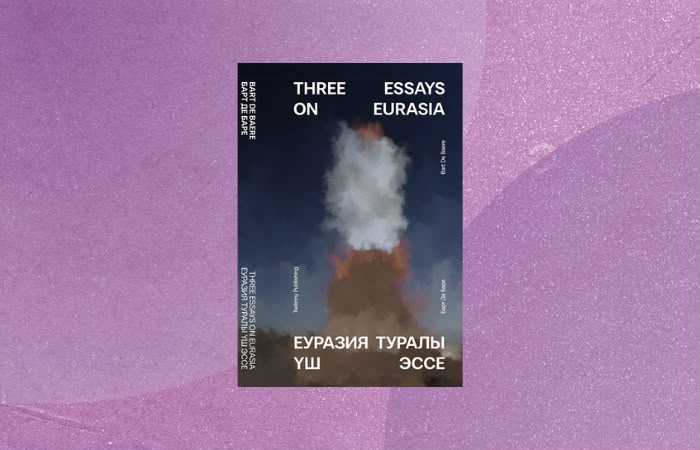


The many futures of Eurasia in Bart de Baere’s “Three Essays on Eurasia”10 min read
Three Essays on Eurasia (Bart de Baere, 2024) explores different futurities, examines current entanglements, and dissects, with a poignant exactitude, the pasts that Eurasia has lived through. More specifically, de Baere weaves together Eurasia’s interconnectedness with other “post-Soviet” spaces and regions (for the lack of a better term) and the world of art — namely through museums and exhibitions, and their function as locations of enacting remembrance and resistance against Russia’s war on Ukraine.
As suggested by its title, de Baere’s book is composed of three different essays: “Eurasia as an Island”, “Eurasia and Transnational Thinking” and “Whatever the Future Will Be, it is Made Now.” “Eurasia as an Island” originally appeared in Bart de Baere, Defne Ayas and Nicolaus Schafhausen’s curatorial project at the 6th Moscow Biennial in 2015, How to Gather? Acting in a Center in a City in the Heart of the Island of Eurasia. Second, “Eurasia and Transnational Thinking” was initially published in Jimie Durham’s Festschrift, edited by Maria Thereza Alves. Finally, “Whatever the Future Will Be, It is Made Now” was written by Bart de Baere and published as part of the Afterall Journal, Issue no. 45 (“Voicings”). It was made available in the online website of the Afterall Research Center (based at the University of the Arts London), and was later translated into Russian and published on syg.ma, an online multilingual media platform.
Bart de Baere is the Director of the M HKA (the Museum of Contemporary Art Antwerpen), and serves on the advisory board of the newly constructed Tselinny Center of Contemporary Art in the city of Almaty, Kazakhstan. In fact, the book was published by the museum’s own imprint: Tselinny Publishing House, in both English and Qazaq. This is both significant and makes practical sense, given that Tselinny strongly advocates for the use of the Qazaq language and the preservation of the cultures and traditions tied to this language, the land and its peoples.
Each of the essays includes a wealth of historical, cultural and art historical references that can be difficult to fully grasp by readers who are only generally acquainted with the theoretical configurations around the notion of “Eurasia”. In this essay, I will try to dissect some of the main ideas that these three pieces enclose.
Essay nº 1: “Eurasia as an Island”
In this essay, written in the immediate wake of Russia’s 2014 annexation of Crimea, de Baere explores the progressive, early 20th-century origins of Russian Eurasianism (as initially conceptualized by the linguist Nikolai Trubetzkoy) in an attempt to expose the vulnerabilities of Western leftist intellectuals who, charmed by Soviet avant-garde legacies and anti-imperialist rhetoric, misjudged the irredentist awakening of the modern Russian state in the 2010s. At the heart of this first essay de Baere attempts to rescue Eurasia from being defined purely by modern state aggression. He transforms it into a space of potential, explicitly asking how we can find a basis for a more grounded and integrated future between peoples, or at least for those who live in Eurasia, concluding that the only hope lies in reintroducing a more complex perspective along what is now called ‘geopolitics’. For de Baere, contemporary geopolitics operates as a flattening, polarizing force and to counter this, he looks forward (and backwards to Trubetzkoy), attempting to untangle the linguist’s Eurasianist 1920s ideas from the aggressive, neo-imperial ideology it was mutated into by contemporary Russian political theorists. De Baere notes that, while Trubetzkoy believed in Eurasia as a platform, he certainly did not subscribe to an ideology of empire.
Here lies the irony that de Baere’s text exposes to the contemporary reader: the text portrays the Soviet Union as an anti-imperial liberator, blind to the reality that Moscow was already re-weaponizing this exact rhetoric to justify its own subjugation of union republics and satellite states. The core of de Baere’s fascination with Trubetzkoy stems from the latter’s background as a linguist who viewed human culture through the fluid mechanics of language. Trubetzkoy famously argued that between neighbouring dialects we find transitional dialects that combine features of both, meaning language is a continuity of dialects, gradually and imperceptibly merging into one another. Because of this structural fluidity, Trubetzkoy felt that the common view of perfectly monolithic, or homogeneous peoples was counterproductive, trivial, or even ignorant. So he mapped this complexity of differentiation right across the landmass of Eurasia, observing that cultures of neighbouring peoples always exhibited comparable features. Within this geography, Asia naturally fell into cultural-historical zones of Islamic, Hindustani, Chinese, Pacific, and Arctic steppe regions. Because the boundaries of these zones would intersect one another, cultures of a mixed, or transnational type emerged, creating what Trubetzkoy termed a “rainbow-like network,” unified and harmonious by virtue of its continuity and infinitely varied by virtue of its differentiation.
For Trubetzkoy historically and de Baere today, the ultimate antidote to imperial chauvinism and geopolitical flattening is a radical, decentralized self-awareness. Trubetzkoy recognized that humans are inherently captive to their own psychology, a conditioning that makes every individual consider the natural group of humans to which they belong to be the most perfect — leading people to believe their own family, state, nation, tribe, or race to be superior to all analogous groups, just as they assume the human race is more perfect than other mammals, and mammals more perfect than other vertebrates. Trubetzkoy viewed self-awareness as the essential basis for dismantling this psychological captivity and establishing mutual respect, since it was from an understanding of their own natures that individuals and nations would come to a full awareness of the equal value of all peoples and nations. De Baere adopts this framework to define the artistic and civic purpose of the museum as a venue for gathering by arguing that such encounters simultaneously enhance self-awareness and awareness of the other.
Essay nº2: “Eurasia and Transnational Thinking”
Three Essays recalibrates its theoretical framework in the second essay, anchoring its analysis along a new axis that spans all the way to Singapore. Rather than viewing Eurasia through the macro-lenses of competing capitals or monolithic empires, de Baere anchors his analysis in the “situated thinking” of the late American Indigenous artist and writer Jimmie Durham. Durham’s philosophy allows de Baere to dismantle the state-centric, heavy-handed borders of traditional Eurasianism. He departs from a baseline realisation discovered — belatedly — by Europe that it is no longer the center of the world, and that we are instead living together on the largest island of the world. By embracing this vast geography as a shared landmass, the essay argues for Eurasia not as a territory to be governed or claimed, but as a web of “relational capacity”, which advocates for decentralized alliances, fluid transnational networks, and micro-histories that bypass traditional state power verticals, though de Baere notes that one of this notion’s limitations is the very space of freedom it allows.
To understand how this works, de Baere examines the historical landscape where the Austro-Hungarian, Ottoman, and Russian empires — in doing battle with each other — were all involved in negotiating the border area between Europe and Asia. He observes that these three empires simply had to tackle diversity, the core group being a minority within its accumulated territory, in order to stay in the driver’s seat. To maintain control, they combined centralisation with a cadavre exquis logic, stitching disparate cultures together into a single administrative body. However, this institutionalised cultural diversity could also have the opposite of an empire’s intended effects, fracturing the very control it sought to establish. In the specific case of Russia, the coherence of statehood was historically based on two distinct notions: the tsar, on the one hand, and the community of the village, on the other. De Baere explains the fractured complexity of this imperial governance through a personal observation, noting that he discovered, when he visited Dagestan, that the Russian Empire had implemented three layers of legislation: it used the Russian law as far as imperial administrative matters were concerned; sharia law to pacify the Islamic population it had subjugated; and, for local matters, applied essentially different legislation from village to village. By invoking historical spaces of blurred demarcation, the text summons a philosophy of dissolving borders, proposing that we may melt away the present’s dividing lines to achieve a more interesting sense of localised diversity and deeper relationships: a model that would reimagine cultural diversity as a constitutive element rather than as an accessory to it. To visualise this fusion, de Baere points to maritime nodes, noting that harbours are by definition a place of contact, exchange and fusion, and can simultaneously embody familiarity and otherness.
This leads to the crucial task of qualifying space without relying on territorial borders. De Baere asks how we can dream of such unity in linked and localised diversity today, answering that, in principle at least, we do not need borders. He points out that border regions most often have a mutual sense of interrelatedness which surpasses the border anyway, asserting that in cultural reality, we don’t base ourselves on borders, even if we abide by them all too often. Instead of political dividing lines, de Baere argues that we need coherent cultural spaces, areas that develop their own sense of groundedness by sharing words, media, opinions and vision.
Essay nº 3: Whatever the Future Will Be, It is Made Now
In a stark turn, Three Essay’s final chapter shatters the speculative theorizing of the previous two. In this essay (written in the immediate aftermath of Russia’s full-scale invasion of Ukraine), de Baere shifts his perspective to one of urgent ethical partisanship, processing a crisis too close for critical comfort. The February 2022 invasion is framed through Jalal Toufic’s concept of a “surpassing disaster” — a cataclysm that goes beyond physical destruction to systematically erase and withdraw the cultural traditions of both the victim and the perpetrator. De Baere outlines how Putin’s aggressive novel nationalism utilises a hollow caricature of Eurasianism to flatten the region’s diversity, turning Trubetzkoy’s original dream of respectful cohabitation into a theory of homogenous subjects or cannon fodder. To de Baere, this state-orchestrated assault creates three distinct killing fields: the physical destruction of Ukraine, the self-inflicted moral suicide of Russian cultural identity, and the total annihilation of the shared relational fabric between the two nations.
Confronted with this catastrophe, de Baere delivers a critique of the international art world, targeting its shallow, mediatic responses and comfortable complacency. He lambasts Western institutions for treating Ukrainian art as a passing trend or temporary hospitality gesture while simultaneously indulging in the self-centered, offensive practice of forcing Ukrainian and Russian artists into premature reconciliation projects. Citing Ukrainian curator Vasyl Cherepanyn, de Baere brands this superficial urge to bypass the victim’s trauma as a “petty-bourgeois ideology” and a comfortable fetish of pacifism. Against this institutional shallowness, the essay demands a rigorous, strategic separation of spaces, asserting that it is first and foremost the victim who must decide when, if ever, to confront the aggressor. True solidarity requires what de Baere terms “capacity sharing” — an active, shared commitment to embedding Ukraine’s autonomous cultural narrative within international reflection, rather than reducing the country to a passive symbol of a war zone.
The text highlights a feeling of resilience by exploring the “constructive criticality” of contemporary Ukrainian artists such as Alevtina Kakhidze, Zhanna Khadyrova, and Nikita Kadan. These figures demonstrate that artistic autonomy coexists with a total commitment to their society’s survival, translating structural military gazes and geopolitical trauma into sharp pictorial questions. This collective responsibility stands in stark contrast to the historical depoliticization and systemic accommodation of state power for which de Baere reproaches the Russian cultural sphere. The essay notes that while a massive exodus of Russian cultural workers from the country has taken place, the strategic challenge for Russian actors — both in exile and internal emigration — lies far beyond passive “anti-war” declarations. Though focusing on Ukraine, this book presents the reader with a broader problematising of the politicised notion of Eurasia, addressed to the context of Kazakhstan, too.